

-
1 asynchronous transmission mode
асинхронный режим передачи (в энергосистеме)
—
[А.С.Гольдберг. Англо-русский энергетический словарь. 2006 г.]Тематики
EN
Англо-русский словарь нормативно-технической терминологии > asynchronous transmission mode
-
2 Asynchronous Transmission Mode (ATM)
асинхронный режим передачи.Способ передачи, при котором начало и конец передаваемого блока информации отмечаются стартовыми и стоповыми битами.English-Russian dictionary of modern telecommunications > Asynchronous Transmission Mode (ATM)
-
3 voice over asynchronous transmission mode
Связь: передача голоса по сети ATM (VoATM)Универсальный англо-русский словарь > voice over asynchronous transmission mode
-
4 mode
1) режим2) состояние3) мода, тип ( волны)•- acoustic mode
- active mode
- adaptive mode
- alternate mode
- ANS/FAX mode
- answering mode
- assemble mode
- asymmetrical mode
- asynchronous balanced mode
- asynchronous transfer mode
- authorized reception mode
- auto document mode
- autoinformer mode
- automatic mode
- automatic reception mode
- auto-night mode
- backup mode
- basic control mode
- biharmonical mode
- bound mode
- buffer mode
- byte mode
- center mark mode
- channel mode
- circuit-transfer mode
- cladding mode
- client-server mode
- coasting mode
- combined mode
- command mode
- common mode
- communication mode
- confidential mode
- continuous emission mode
- continuous mode
- conversational mode
- correction mode
- coupled modes
- cutoff mode
- data mode
- data-processing mode
- day/night mode
- delayed ARM mode
- DEMO mode
- detail mode
- detection mode
- direct sending mode
- display mode
- dual mode
- duplex mode
- erase mode
- evanescent mode
- executive mode
- expansion modes
- external synchronization mode
- Fax mode
- fine mode
- first-type oscillation mode
- forced mode
- frame mode
- fundamental mode
- generator mode
- ghost mode
- group mode
- guard mode
- half-duplex mode
- half-speed mode
- half-tone mode
- hierarchical mode
- high-power mode
- holding mode
- hollow-beam mode
- home-only mode
- hybrid mode
- idling mode
- instant ARM mode
- internal synchronization mode
- interrupt mode
- interruptible current mode
- inversed mode
- key mode
- landscape mode
- leaky mode
- light-tensioned mode
- limiting mode
- linear mode
- line-art mode
- line-hold mode
- line-holding mode
- listening mode
- local mode
- lock mode
- long-distance mode
- long-play mode
- long-time mode
- loudly mode
- low signal mode
- lugdown mode
- macroblock mode
- magnetostatic mode
- manual mode
- master mode
- matched operation mode
- matching mode
- memory lock mode
- minimal mode
- mode of behavior
- modulated mode
- monitor mode
- mono mode
- multicopy mode
- multiplex mode
- multipoint mode
- multisort document reception mode
- net mode
- nonpublic mode
- nontransparent mode
- normal mode
- off mode
- off-normal mode
- on-line mode
- on-link mode
- open-phase mode
- operating mode
- orthonormal modes
- overseas mode
- overtensioned mode
- parallel mode
- part load mode
- partial load mode
- peak mode
- periodic mode
- phone-only mode
- photo mode
- photodiode mode
- photogalvanic mode
- phototransistor mode
- pilot mode
- playback mode
- polling reception mode
- polling standby mode
- polling-transmission mode
- portrait mode
- potential mode
- precritical mode
- prediction mode
- printer mode
- private mode
- propagation mode
- pulsed mode
- quasi-cyclic mode
- quasi-key mode
- quick-record mode
- radiation mode
- rated power mode
- real-time mode
- receive mode
- recursive short-time mode
- redial mode
- remote-receiving mode
- rental mode
- rest mode
- reversing mode
- running-wave mode
- sample-and-hold mode
- saturation mode
- save dial mode
- scan mode
- second-type oscillation mode
- self-exciting oscillation mode
- self-oscillating mode
- send later mode
- sequential lossless mode
- serial mode
- series mode
- servicing mode
- setup mode
- shared fax mode
- short-time mode
- silence detection mode
- silently mode
- sleep mode
- soft self-exciting mode
- soft-control mode
- soft-controlling mode
- sound mode
- special scanning mode
- standard mode
- standby mode
- standing wave mode
- start mode
- starting mode
- start-stop mode
- stereo mode
- stop mode
- storage mode
- substitute reception mode
- superfine mode
- switching mode
- symmetrical mode
- synchronous-transfer mode
- synchronous-transmission mode
- TEL mode
- TEL/FAX mode
- telegraph mode
- telephone mode
- tensioned mode
- transfer mode
- transmission dead-line mode
- transmission mode
- transverse electric-and-magnetic mode
- transverse magnetic mode
- transverse-electric mode
- traveling wave mode
- triggering mode
- tuning mode
- uncoupled modes
- undertensioned mode
- unlock mode
- unstable mode
- valve mode
- vibrating mode
- voice-call mode
- waiting mode
- winding mode
- wireless-access mode
- XX modeEnglish-Russian dictionary of telecommunications and their abbreviations > mode
-
5 mode
1) модаа) нормальный тип колебаний, собственный тип колебаний; нормальный тип волн, собственный тип волн3) способ; метод4) тип; форма ( выражения или проявления чего-либо)6) ак. лад; тональность•- π-mode- 1284 compliance mode
- 32-bit mode
- 32-bit transfer mode
- 8086 real mode
- accelerated transit mode
- accumulation-layer mode
- acoustic mode
- active mode
- address mode
- adjacent modes
- all points addressable mode
- alpha mode
- alphanumeric mode
- alternate mode
- AN mode
- analog mode
- angular dependent mode
- angular mode
- anomalous mode
- answer mode
- antiferrodistortive mode
- antiferromagnetic mode
- anti-Stokes mode
- antisymmetric mode
- APA mode
- aperiodic mode
- asymmetric mode
- asynchronous balanced mode
- asynchronous response mode
- asynchronous transfer mode
- auto-answer mode
- auto-dial mode
- avalanche mode
- axial mode
- background mode
- backward mode
- beam mode
- beam-waveguide mode
- Bi-Di mode
- bidirectional mode
- BIOS video mode
- birefringent mode
- bistable mode
- bitmap mode
- black-and-white mode
- block mode
- block-multiplex mode
- blow-up mode
- browse mode
- burst mode
- byte mode
- calculator mode
- central mode
- characteristic mode
- chat mode
- chip test mode
- CHS mode
- circle-dot mode
- circular mode
- circularly polarized mode
- circularly symmetric mode
- clockwise mode
- CMY mode
- CMYK mode
- collective modes
- color mode
- command mode
- common mode
- communications mode
- compatibility mode
- competing modes
- concert hall reverberation mode
- configuration mode
- constant-frequency mode
- contention mode
- continuous-wave mode
- contour modes
- control mode
- conversational mode
- cooked mode
- correlator mode
- counter mode
- counterclockwise mode
- coupled modes
- crossover mode
- current mode
- cutoff mode
- cw mode
- cyclotron mode
- cylinder-head-sector mode
- damped mode
- data-in mode
- data-out mode
- Debye mode
- Debye-like mode
- defocus-dash mode
- defocus-focus mode
- degenerate mode
- delayed domain mode
- depletion mode
- deposition mode
- difference mode
- differential mode
- diffusive mode
- digital mode
- dipole mode
- direct memory access transfer mode
- disk-at-once mode
- display mode
- dissymmetric mode
- DMA transfer mode
- domain mode
- dominant mode
- dot-addressable mode
- dot-dash mode
- doze mode
- draft mode
- drift mode
- ducted mode
- duotone mode
- duplex mode
- dynamic mode
- dynamic scattering mode
- E mode
- Emn mode
- ECHS mode
- ECP mode
- edge mode
- edit mode
- eigen mode
- electromagnetic mode
- elementary mode
- elliptically polarized mode
- embedded mode
- end-fire mode
- enhanced parallel port mode
- enhanced virtual 8086 mode
- enhanced virtual 86 mode
- enhancement mode
- EPP mode
- equiamplitude modes
- EV8086 mode
- EV86 mode
- evanescent mode
- even mode
- even-order mode
- even-symmetrical mode
- exchange mode
- exchange-dominated mode
- excited mode
- exciting mode
- extended capability port mode
- extended cylinder-head-sector mode
- extensional mode
- extraordinary mode
- FA mode
- face shear modes
- failure mode
- fast mode
- fast-forward mode
- ferrite-air mode
- ferrite-dielectric mode
- ferrite-guided mode
- ferrite-metal mode
- ferrodistortive mode
- ferroelectric mode
- file mode
- first mode
- FM mode
- forbidden mode
- force mode
- foreground mode
- forward mode
- forward-bias mode
- forward-propagating mode
- forward-scattered mode
- four-color mode
- four-output mode
- free-running mode
- full on mode
- fundamental mode
- gate mode
- Gaussian mode
- Goldstone mode
- graphic display mode
- graphic mode
- gray-level mode
- grayscale mode
- guided mode
- guided-wave mode
- Gunn mode
- gyromagnetic mode
- H mode
- Hmn mode
- half-duplex mode
- half-tone mode
- hard mode
- harmonic mode
- helicon mode
- Hermite-Gaussian mode
- higher mode
- higher-order mode
- HLS mode
- HSB mode
- HSV mode
- hybrid mode
- idling mode
- impact avalanche transit-time mode
- IMPATT mode
- indexed color mode
- inhibited domain mode
- initialization mode
- injection locked mode
- insert mode
- interactive mode
- internally-trapped mode
- interstitial diffusion mode
- ion-implantation channel mode
- ion-sound mode
- kernel mode
- kiosk mode
- L*a*b* mode
- landscape mode
- large disk mode
- lasing mode
- lattice mode
- laying mode
- LBA mode
- LCH mode
- leaky mode
- left-hand polarized mode
- left-handed polarized mode
- length modes
- letter mode
- LH mode
- limited space-charge accumulation mode
- line art mode
- local mode
- lock mode
- logical block addressing mode
- log-periodically coupled modes
- longitudinal mode
- loopback mode
- lowest mode
- lowest-order mode
- low-power mode
- LSA mode
- magnetic mode
- magnetodynamical mode
- magnetoelastic mode
- magnetosonic mode
- magnetostatic mode
- magnetron mode
- main mode
- masing mode
- master/slave mode
- mixed mode
- mode of excitation
- mode of operation
- modified semistatic mode
- modulated transit-time mode
- module test mode
- mono mode
- mono/stereo mode
- monopulse mode
- moving-target indication mode
- MTI mode
- multi mode
- multichannel mode
- multimode mode
- multiple sector mode
- multiplex mode
- mutual orthogonal modes
- native mode
- natural mode
- near-letter mode
- nibble mode
- nondegenerated mode
- non-privileged mode
- nonpropagating mode
- nonresonant mode
- nonuniform processional mode
- normal mode
- normal-incidence mode
- odd mode
- odd-order mode
- odd-symmetrical mode
- off mode
- off-axial mode
- off-line mode
- omni mode
- on mode
- on-line mode
- operation mode
- optical mode
- ordinary mode
- original mode
- originate mode
- orthogonal modes
- OS/2 compatible mode
- overdamped mode
- overtype mode
- packet mode
- packet transfer mode
- page mode
- parallel port FIFO mode
- parametric mode
- parasitic mode
- pedestal-current stabilized mode
- penetration mode
- persistent-current mode
- perturbated mode
- phonon mode
- pi mode
- PIO mode
- plane mode
- plane polarized mode
- plasma mode
- plasma-guide mode
- playback mode
- polarized mode
- poly mode
- portrait mode
- preferred mode
- principal mode
- privileged mode
- programmed input/output mode
- promiscuous mode
- protected mode
- protected virtual address mode
- proton mode
- pseudo-Rayleigh mode
- pseudospin mode
- pseudospin-wave mode
- pulse mode
- quadrupole mode
- quadtone mode
- quasi-degenerated mode
- quenched domain mode
- quenched multiple-domain mode
- quenched single-domain mode
- question-and-answer mode
- radial mode
- radiating mode
- radiation mode
- Raman active mode
- ranging mode
- rare mode
- raw mode
- RB mode
- read multiple mode
- read-mostly mode
- real address mode
- real mode
- real-time mode
- receive mode
- reflected mode
- reflection mode
- refracted mode
- rehearse mode
- relaxational mode
- resonant mode
- return-beam mode
- reverberation mode
- reverse-bias mode
- rewind mode
- RGB mode
- RH mode
- rho-rho mode
- right-hand polarized mode
- right-handed polarized mode
- safe mode
- saturated-off mode of operation
- saturation mode
- saving mode
- scan mode
- search mode
- secondary-emission pedestal mode
- second-breakdown mode
- self-localized mode
- self-locked mode
- semistatic mode
- shear mode
- shutdown mode
- side modes
- simplex mode
- single mode
- single-vortex cycle mode
- slave mode
- sleep mode
- slow mode
- small room reverberation mode
- soft mode
- softened mode
- sorcerer's apprentice mode
- space-charge feedback mode
- space-charge mode
- spatially orthogonal modes
- special fully nested mode
- spiking mode
- spin mode
- spin-wave mode
- SPP mode
- spurious mode
- spurious pulse mode
- stable mode
- stable-negative-resistance mode
- standard parallel port mode - stationary mode
- Stokes mode
- stop clock mode
- stop mode
- stream mode
- subharmonic mode
- substitutional-diffusion mode
- subsurface mode
- sum mode
- superradiant mode
- supervisor mode
- surface skimming mode
- surface-wave mode
- suspend mode
- SVGA mode
- switching mode
- symmetric mode
- symmetry breaking mode
- symmetry restoring mode
- system management mode
- system test mode
- Tmnp wave resonant mode
- task mode
- TE mode
- TEmnp wave resonant mode
- tearing mode
- telegraph mode
- TEM mode
- terminal mode
- test mode
- text mode
- thermal mode
- thickness modes
- three-color mode
- through mode
- time-difference mode
- time-sharing mode
- TM mode
- TMmnp wave resonant mode
- torsional modes
- total-internal reflection mode
- track-at-once mode
- transfer mode
- transient mode
- transit-time domain mode
- transit-time mode
- transmission mode
- transmitted mode
- transmitting mode
- transverse electric mode
- transverse electromagnetic mode
- transverse magnetic mode
- transverse mode
- transversely polarized mode
- transverse-symmetrical mode
- TRAPATT mode
- trapped mode
- trapped plasma avalanche transit-time mode
- trapped-domain mode
- traveling space-charge mode
- traveling-wave mode
- tristate test mode
- tritone mode
- truncated mode
- twist mode
- twisted nematic mode
- TXT mode
- typeover mode
- uncoupled modes
- undamped mode
- underdamped mode
- unguided mode
- unidirectional mode
- unilateral mode
- unperturbed mode
- unreal mode
- unstable mode
- unwanted mode
- user mode
- V8086 mode
- V86 mode
- VGA mode
- vibration mode
- video mode
- virtual 8086 mode
- virtual 86 mode
- virtual real mode
- volume magnetostatic mode
- wait for key mode
- waiting mode
- Walker mode
- walk-off mode
- wave mode
- waveguide mode
- whispering-gallery mode
- whistler mode
- width modes
- write mode
- write multiple mode
- zero-frequency mode
- zero-order modeThe New English-Russian Dictionary of Radio-electronics > mode
-
6 asynchronous
= async I; = asynch; = ASYNCHасинхронный, не синхронный, несинхронизированныйпроисходящий независимо, не синхронизуемый общим сигналом, т. е., как следствие, не происходящий в регулярные или предсказуемые интервалы времени.Syn:Ant:Англо-русский толковый словарь терминов и сокращений по ВТ, Интернету и программированию. > asynchronous
-
7 asynchronous
a асинхронный -
8 asynchronous
-
9 asynchronous mode
Англо-русский толковый словарь терминов и сокращений по ВТ, Интернету и программированию. > asynchronous mode
-
10 Hardware Address Type
Протокол; Сеть Тип аппаратного адреса Поле ARP-пакетов, определяющее канальный протокол, для которого ARP производит разрешение аппаратного адреса в IP-адрес. Все значения данного поля описаны в RFC1700. 1 - Ethernet (10Mb) - [JBP] 2 - Experimental Ethernet (3Mb) - [JBP] 3 - Amateur Radio AX.25 - [PXK] 4 - Proteon ProNET Token Ring - [JBP] 5 - Chaos - [GXP] 6 - IEEE 802 Networks - [JBP] 7 - ARCNET - [JBP] 8 - Hyperchannel - [JBP] 9 - Lanstar - [TU] 10 - Autonet Short Address - [MXB1] 11 - LocalTalk - [JKR1] 12 - LocalNet (IBM PCNet or SYTEK LocalNET) - [JXM] 13 - Ultra link - [RXD2] 14 - SMDS - [GXC1] 15 - Frame Relay - [AGM] 16 - Asynchronous Transmission Mode (ATM) - [JXB2] 17 - HDLC - [JBP] 18 - Fiber Channel - [Yakov Rekhter] 19 - Asynchronous Transmission Mode (ATM) - [Mark Laubach] 20 - Serial Line - [JBP] 21 - Asynchronous Transmission Mode (ATM) - [MXB1]English-Russian dictionary of computer abbreviations and terms > Hardware Address Type
-
11 VoATM
-
12 WATM
1) Компьютерная техника: Wireless Asynchronous Transmission Mode2) Телевидение: TV-23, Altoona, Pennsylvania -
13 ATM
English-Russian dictionary of modern telecommunications > ATM
-
14 system
1) система || системный3) вчт операционная система; программа-супервизор5) вчт большая программа6) метод; способ; алгоритм•system halted — "система остановлена" ( экранное сообщение об остановке компьютера при наличии серьёзной ошибки)
- CPsystem- H-system- h-system- hydrogen-air/lead battery hybrid system- Ksystem- Lsystem- L*a*b* system- master/slave computer system- p-system- y-system- Δ-system -
15 terminal
1) терминал, оконечное устройство || терминальный, оконечный2) конечный слог; конечное слово3) терминальный символ, терминал ( в формальной грамматике)4) зажим, клемма; вывод || выводной•- all terminals are in use
- alphanumeric-display terminal
- alphameric-display terminal
- ASCII terminal
- asynchronous terminal
- audio terminal
- automatic dictation terminal
- base terminal
- batch terminal
- bit-plane-memory terminal
- block-feed terminal
- booking terminal
- buffered terminal
- cathode-ray tube terminal
- character terminal
- character-at-a-time terminal
- cluster terminal
- collector terminal
- communication line terminal
- communications terminal
- console terminal
- control terminal
- CRT-based terminal
- CRT terminal
- data terminal
- data-communication terminal
- data-entry terminal
- data-transmission terminal
- dedicated memory terminal
- desk-top terminal
- dial-up terminal
- dictation terminal
- directed-beam refresh terminal
- display terminal
- dumb terminal
- edge-assigned terminal
- editing terminal
- enemy terminal
- fixed terminal
- floating terminal
- graphic display terminal
- graphic terminal
- hardcopy terminal
- idle terminal
- input-output data terminal
- inquiry terminal
- intelligent terminal
- interactive terminal
- job-entry terminal
- job-oriented terminal
- lightwave terminal
- local terminal
- logical terminal
- masquerading terminal
- master terminal
- multiplex data terminal
- network terminal
- office terminal
- orphan terminal
- packet-mode terminal
- packet terminal
- paging terminal
- patchbay terminal
- point-of-sale terminal
- printer terminal
- processing terminal
- programmable terminal
- propagating terminal
- receive-only terminal
- receiving terminal
- remote terminal
- remote-batch terminal
- screw terminal
- scroll-mode virtual terminal
- scroll-mode terminal
- security terminal
- send-receive terminal
- smart terminal
- soft-copy terminal
- softkey terminal
- starting terminal
- synchronous terminal
- talking terminal
- target terminal
- telecommunication terminal
- television-type terminal
- television terminal
- teller terminal
- touch-sensitive terminal
- typing terminal
- unattended terminal
- user terminal
- very small aperture terminal
- video display terminal
- video terminal
- video keyboard terminal
- videotex terminal
- virtual terminal
- voice entry terminal
- voice terminalEnglish-Russian dictionary of computer science and programming > terminal
-
16 DOL
- эффект операционного рычага
- пускатель прямого действия
- прямой пуск вращающегося электродвигателя
- Министерство труда (США)
- концентрация растворённого кислорода
концентрация растворённого кислорода
—
[А.С.Гольдберг. Англо-русский энергетический словарь. 2006 г.]Тематики
EN
Министерство труда (США)
—
[А.С.Гольдберг. Англо-русский энергетический словарь. 2006 г.]Тематики
EN
прямой пуск вращающегося электродвигателя
Пуск вращающегося электродвигателя путем непосредственного подключения его к питающей сети.
[ ГОСТ 27471-87]EN
direct-on-line starting
across-the-line starting (US)
the process of starting a motor by connecting it directly to the supply at rated voltage
[IEV number 411-52-15]FR
démarrage direct
mode de démarrage d'un moteur, consistant à lui appliquer directement sa pleine tension assignée
[IEV number 411-52-15]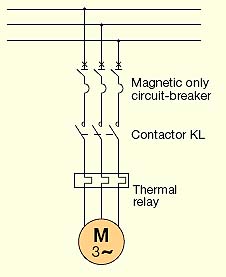
Рис. ABB
Схема прямого пуска электродвигателяMagnetic only circuit-breaker - Автоматический выключатель с электромагнитным расцепителем
Contactor KL - Контактор KL
Thermal relay - Тепловое реле
Параллельные тексты EN-RU
Direct-on-line starting
Direct-on-line starting, which is often abbreviated as DOL, is perhaps the most traditional system and consists in connecting the motor directly to the supply network, thus carrying out starting at full voltage.Direct-on-line starting represents the simplest and the most economical system to start a squirrel-cage asynchronous motor and it is the most used.
As represented in Figure 5, it provides the direct connection to the supply network and therefore starting is carried out at full voltage and with constant frequency, developing a high starting torque with very reduced acceleration times.
The typical applications are relevant to small power motors also with full load starting.
These advantages are linked to some problems such as, for example, the high inrush current, which - in the first instants - can reach values of about 10 to 12 times the rated current, then can decrease to about 6 to 8 times the rated current and can persist to reach the maximum torque speed.The effects of such currents can be identified with the high electro-dynamical stresses on the motor connection cables and could affect also the windings of the motor itself; besides, the high inrush torques can cause violent accelerations which stress the transmission components (belts and joints) generating distribution problems with a reduction in the mechanical life of these elements.
Finally, also the possible electrical problems due to voltage drops on the supply line of the motor or of the connected equipment must be taken into consideration.
[ABB]Прямой пуск
Прямой пуск, который по-английски часто сокращенно обозначают как DOL, является, пожалуй наиболее распространенным способом пуска. Он заключается в непосредственном (т. е. прямом) подключении двигателя к питающей сети. Это означает, что пуск двигателя осуществляется при полном напряжении.Схема прямого пуска является наиболее простым, экономичным и чаще всего применяемым решением для электродвигателей с короткозамкнутым ротором.
Схема прямого подключения к сети представлена на рисунке 5. Пуск осуществляется при полном напряжении и постоянной частоте сети. Электродвигатель развивает высокий пусковой момент при коротком времени разгона.
Типичные области применения – маломощные электродвигатели, в том числе с пуском при полной нагрузке.
Однако, наряду с преимуществами имеются и определенные недостатки, например, бросок пускового тока, достигающий в первоначальный момент 10…12-кратного значения от номинального тока электродвигателя. Затем ток двигателя уменьшается примерно до 6…8-кратного значения номинального тока и будет держаться на этом уровне до тех пор, пока скорость двигателя не достигнет максимального значения.
Такое изменение тока оказывает значительное электродинамическое воздействие на кабель, подключенный к двигателю. Кроме того пусковой ток воздействует на обмотки двигателя. Высокий начальный пусковой момент может привести к значительному ускорению и следовательно к значительной нагрузке элементов привода (ремней, крепления узлов), что вызывает сокращение их срока службы.
И, наконец, следует принять во внимание возможное возникновение проблем, связанных с падением напряжения в линии питания двигателя и подключенного к этой линии оборудования.
[Перевод Интент]
Тематики
Синонимы
EN
- across-the-line starting (US)
- direct line starting
- direct operation of a motor
- direct starting
- direct-on-line starting
- DOL
- full voltage starter application
DE
FR
пускатель прямого действия
Пускатель, одноступенчато подающий сетевое напряжение на выводы двигателя.
(МЭС 441-14-40)
[ ГОСТ Р 50030.4.1-2002 (МЭК 60947-4-1-2000)]
Пускатели переменного тока для прямого непосредственного пуска (с полным напряжением)
Пускатели, предназначенные для пуска двигателя, разгона его до номинальной скорости, защиты двигателя и подключенных к нему цепей от рабочих перегрузок и отключения питания двигателя.
[ ГОСТ Р 50030.4.1-2002 (МЭК 60947-4-1-2000)]EN
direct-on-line starter
a starter which connects the line voltage across the motor terminals in one step
[IEV number 441-14-40]FR
démarreur direct
démarreur qui applique la tension d'alimentation sur les bornes du moteur en une seule manoeuvre
[IEV number 441-14-40]Параллельные тексты EN-RU
Direct-on-line starters
Starters which connect the line voltage across the motor terminals in one step, intended to start and accelerate a motor to normal speed.
They shall ensure switching and protection functions as prescribed in the general definition.
[ABB]Пускатели прямого действия
Пускатели, одноступенчато подающие сетевое напряжение на зажимы двигателя и предназначенные для его пуска и разгона до номинальной скорости.
Кроме того, они должны обеспечивать коммутацию и защиту в соответствии с общим определением.
[Перевод Интент]Тематики
EN
DE
FR
эффект операционного рычага
эффект производственного рычага
Эффект операционного рычага - выражение того факта, что любое изменение выручки от реализации порождает изменение прибыли. Сила воздействия операционного рычага вычисляется как частное от деления выручки от реализации после возмещения переменных затрат на прибыль.
[ http://www.lexikon.ru/dict/fin/a.html]Тематики
Синонимы
EN
Англо-русский словарь нормативно-технической терминологии > DOL
-
17 direct starting
прямой пуск
—
[Я.Н.Лугинский, М.С.Фези-Жилинская, Ю.С.Кабиров. Англо-русский словарь по электротехнике и электроэнергетике, Москва, 1999 г.]Тематики
- электротехника, основные понятия
EN
прямой пуск вращающегося электродвигателя
Пуск вращающегося электродвигателя путем непосредственного подключения его к питающей сети.
[ ГОСТ 27471-87]EN
direct-on-line starting
across-the-line starting (US)
the process of starting a motor by connecting it directly to the supply at rated voltage
[IEV number 411-52-15]FR
démarrage direct
mode de démarrage d'un moteur, consistant à lui appliquer directement sa pleine tension assignée
[IEV number 411-52-15]
Рис. ABB
Схема прямого пуска электродвигателяMagnetic only circuit-breaker - Автоматический выключатель с электромагнитным расцепителем
Contactor KL - Контактор KL
Thermal relay - Тепловое реле
Параллельные тексты EN-RU
Direct-on-line starting
Direct-on-line starting, which is often abbreviated as DOL, is perhaps the most traditional system and consists in connecting the motor directly to the supply network, thus carrying out starting at full voltage.Direct-on-line starting represents the simplest and the most economical system to start a squirrel-cage asynchronous motor and it is the most used.
As represented in Figure 5, it provides the direct connection to the supply network and therefore starting is carried out at full voltage and with constant frequency, developing a high starting torque with very reduced acceleration times.
The typical applications are relevant to small power motors also with full load starting.
These advantages are linked to some problems such as, for example, the high inrush current, which - in the first instants - can reach values of about 10 to 12 times the rated current, then can decrease to about 6 to 8 times the rated current and can persist to reach the maximum torque speed.The effects of such currents can be identified with the high electro-dynamical stresses on the motor connection cables and could affect also the windings of the motor itself; besides, the high inrush torques can cause violent accelerations which stress the transmission components (belts and joints) generating distribution problems with a reduction in the mechanical life of these elements.
Finally, also the possible electrical problems due to voltage drops on the supply line of the motor or of the connected equipment must be taken into consideration.
[ABB]Прямой пуск
Прямой пуск, который по-английски часто сокращенно обозначают как DOL, является, пожалуй наиболее распространенным способом пуска. Он заключается в непосредственном (т. е. прямом) подключении двигателя к питающей сети. Это означает, что пуск двигателя осуществляется при полном напряжении.Схема прямого пуска является наиболее простым, экономичным и чаще всего применяемым решением для электродвигателей с короткозамкнутым ротором.
Схема прямого подключения к сети представлена на рисунке 5. Пуск осуществляется при полном напряжении и постоянной частоте сети. Электродвигатель развивает высокий пусковой момент при коротком времени разгона.
Типичные области применения – маломощные электродвигатели, в том числе с пуском при полной нагрузке.
Однако, наряду с преимуществами имеются и определенные недостатки, например, бросок пускового тока, достигающий в первоначальный момент 10…12-кратного значения от номинального тока электродвигателя. Затем ток двигателя уменьшается примерно до 6…8-кратного значения номинального тока и будет держаться на этом уровне до тех пор, пока скорость двигателя не достигнет максимального значения.
Такое изменение тока оказывает значительное электродинамическое воздействие на кабель, подключенный к двигателю. Кроме того пусковой ток воздействует на обмотки двигателя. Высокий начальный пусковой момент может привести к значительному ускорению и следовательно к значительной нагрузке элементов привода (ремней, крепления узлов), что вызывает сокращение их срока службы.
И, наконец, следует принять во внимание возможное возникновение проблем, связанных с падением напряжения в линии питания двигателя и подключенного к этой линии оборудования.
[Перевод Интент]
Тематики
Синонимы
EN
- across-the-line starting (US)
- direct line starting
- direct operation of a motor
- direct starting
- direct-on-line starting
- DOL
- full voltage starter application
DE
FR
Англо-русский словарь нормативно-технической терминологии > direct starting
-
18 across-the-line starting (US)
прямой пуск вращающегося электродвигателя
Пуск вращающегося электродвигателя путем непосредственного подключения его к питающей сети.
[ ГОСТ 27471-87]EN
direct-on-line starting
across-the-line starting (US)
the process of starting a motor by connecting it directly to the supply at rated voltage
[IEV number 411-52-15]FR
démarrage direct
mode de démarrage d'un moteur, consistant à lui appliquer directement sa pleine tension assignée
[IEV number 411-52-15]
Рис. ABB
Схема прямого пуска электродвигателяMagnetic only circuit-breaker - Автоматический выключатель с электромагнитным расцепителем
Contactor KL - Контактор KL
Thermal relay - Тепловое реле
Параллельные тексты EN-RU
Direct-on-line starting
Direct-on-line starting, which is often abbreviated as DOL, is perhaps the most traditional system and consists in connecting the motor directly to the supply network, thus carrying out starting at full voltage.Direct-on-line starting represents the simplest and the most economical system to start a squirrel-cage asynchronous motor and it is the most used.
As represented in Figure 5, it provides the direct connection to the supply network and therefore starting is carried out at full voltage and with constant frequency, developing a high starting torque with very reduced acceleration times.
The typical applications are relevant to small power motors also with full load starting.
These advantages are linked to some problems such as, for example, the high inrush current, which - in the first instants - can reach values of about 10 to 12 times the rated current, then can decrease to about 6 to 8 times the rated current and can persist to reach the maximum torque speed.The effects of such currents can be identified with the high electro-dynamical stresses on the motor connection cables and could affect also the windings of the motor itself; besides, the high inrush torques can cause violent accelerations which stress the transmission components (belts and joints) generating distribution problems with a reduction in the mechanical life of these elements.
Finally, also the possible electrical problems due to voltage drops on the supply line of the motor or of the connected equipment must be taken into consideration.
[ABB]Прямой пуск
Прямой пуск, который по-английски часто сокращенно обозначают как DOL, является, пожалуй наиболее распространенным способом пуска. Он заключается в непосредственном (т. е. прямом) подключении двигателя к питающей сети. Это означает, что пуск двигателя осуществляется при полном напряжении.Схема прямого пуска является наиболее простым, экономичным и чаще всего применяемым решением для электродвигателей с короткозамкнутым ротором.
Схема прямого подключения к сети представлена на рисунке 5. Пуск осуществляется при полном напряжении и постоянной частоте сети. Электродвигатель развивает высокий пусковой момент при коротком времени разгона.
Типичные области применения – маломощные электродвигатели, в том числе с пуском при полной нагрузке.
Однако, наряду с преимуществами имеются и определенные недостатки, например, бросок пускового тока, достигающий в первоначальный момент 10…12-кратного значения от номинального тока электродвигателя. Затем ток двигателя уменьшается примерно до 6…8-кратного значения номинального тока и будет держаться на этом уровне до тех пор, пока скорость двигателя не достигнет максимального значения.
Такое изменение тока оказывает значительное электродинамическое воздействие на кабель, подключенный к двигателю. Кроме того пусковой ток воздействует на обмотки двигателя. Высокий начальный пусковой момент может привести к значительному ускорению и следовательно к значительной нагрузке элементов привода (ремней, крепления узлов), что вызывает сокращение их срока службы.
И, наконец, следует принять во внимание возможное возникновение проблем, связанных с падением напряжения в линии питания двигателя и подключенного к этой линии оборудования.
[Перевод Интент]
Тематики
Синонимы
EN
- across-the-line starting (US)
- direct line starting
- direct operation of a motor
- direct starting
- direct-on-line starting
- DOL
- full voltage starter application
DE
FR
Англо-русский словарь нормативно-технической терминологии > across-the-line starting (US)
-
19 direct line starting
прямой пуск вращающегося электродвигателя
Пуск вращающегося электродвигателя путем непосредственного подключения его к питающей сети.
[ ГОСТ 27471-87]EN
direct-on-line starting
across-the-line starting (US)
the process of starting a motor by connecting it directly to the supply at rated voltage
[IEV number 411-52-15]FR
démarrage direct
mode de démarrage d'un moteur, consistant à lui appliquer directement sa pleine tension assignée
[IEV number 411-52-15]
Рис. ABB
Схема прямого пуска электродвигателяMagnetic only circuit-breaker - Автоматический выключатель с электромагнитным расцепителем
Contactor KL - Контактор KL
Thermal relay - Тепловое реле
Параллельные тексты EN-RU
Direct-on-line starting
Direct-on-line starting, which is often abbreviated as DOL, is perhaps the most traditional system and consists in connecting the motor directly to the supply network, thus carrying out starting at full voltage.Direct-on-line starting represents the simplest and the most economical system to start a squirrel-cage asynchronous motor and it is the most used.
As represented in Figure 5, it provides the direct connection to the supply network and therefore starting is carried out at full voltage and with constant frequency, developing a high starting torque with very reduced acceleration times.
The typical applications are relevant to small power motors also with full load starting.
These advantages are linked to some problems such as, for example, the high inrush current, which - in the first instants - can reach values of about 10 to 12 times the rated current, then can decrease to about 6 to 8 times the rated current and can persist to reach the maximum torque speed.The effects of such currents can be identified with the high electro-dynamical stresses on the motor connection cables and could affect also the windings of the motor itself; besides, the high inrush torques can cause violent accelerations which stress the transmission components (belts and joints) generating distribution problems with a reduction in the mechanical life of these elements.
Finally, also the possible electrical problems due to voltage drops on the supply line of the motor or of the connected equipment must be taken into consideration.
[ABB]Прямой пуск
Прямой пуск, который по-английски часто сокращенно обозначают как DOL, является, пожалуй наиболее распространенным способом пуска. Он заключается в непосредственном (т. е. прямом) подключении двигателя к питающей сети. Это означает, что пуск двигателя осуществляется при полном напряжении.Схема прямого пуска является наиболее простым, экономичным и чаще всего применяемым решением для электродвигателей с короткозамкнутым ротором.
Схема прямого подключения к сети представлена на рисунке 5. Пуск осуществляется при полном напряжении и постоянной частоте сети. Электродвигатель развивает высокий пусковой момент при коротком времени разгона.
Типичные области применения – маломощные электродвигатели, в том числе с пуском при полной нагрузке.
Однако, наряду с преимуществами имеются и определенные недостатки, например, бросок пускового тока, достигающий в первоначальный момент 10…12-кратного значения от номинального тока электродвигателя. Затем ток двигателя уменьшается примерно до 6…8-кратного значения номинального тока и будет держаться на этом уровне до тех пор, пока скорость двигателя не достигнет максимального значения.
Такое изменение тока оказывает значительное электродинамическое воздействие на кабель, подключенный к двигателю. Кроме того пусковой ток воздействует на обмотки двигателя. Высокий начальный пусковой момент может привести к значительному ускорению и следовательно к значительной нагрузке элементов привода (ремней, крепления узлов), что вызывает сокращение их срока службы.
И, наконец, следует принять во внимание возможное возникновение проблем, связанных с падением напряжения в линии питания двигателя и подключенного к этой линии оборудования.
[Перевод Интент]
Тематики
Синонимы
EN
- across-the-line starting (US)
- direct line starting
- direct operation of a motor
- direct starting
- direct-on-line starting
- DOL
- full voltage starter application
DE
FR
Англо-русский словарь нормативно-технической терминологии > direct line starting
-
20 direct operation of a motor
прямой пуск вращающегося электродвигателя
Пуск вращающегося электродвигателя путем непосредственного подключения его к питающей сети.
[ ГОСТ 27471-87]EN
direct-on-line starting
across-the-line starting (US)
the process of starting a motor by connecting it directly to the supply at rated voltage
[IEV number 411-52-15]FR
démarrage direct
mode de démarrage d'un moteur, consistant à lui appliquer directement sa pleine tension assignée
[IEV number 411-52-15]
Рис. ABB
Схема прямого пуска электродвигателяMagnetic only circuit-breaker - Автоматический выключатель с электромагнитным расцепителем
Contactor KL - Контактор KL
Thermal relay - Тепловое реле
Параллельные тексты EN-RU
Direct-on-line starting
Direct-on-line starting, which is often abbreviated as DOL, is perhaps the most traditional system and consists in connecting the motor directly to the supply network, thus carrying out starting at full voltage.Direct-on-line starting represents the simplest and the most economical system to start a squirrel-cage asynchronous motor and it is the most used.
As represented in Figure 5, it provides the direct connection to the supply network and therefore starting is carried out at full voltage and with constant frequency, developing a high starting torque with very reduced acceleration times.
The typical applications are relevant to small power motors also with full load starting.
These advantages are linked to some problems such as, for example, the high inrush current, which - in the first instants - can reach values of about 10 to 12 times the rated current, then can decrease to about 6 to 8 times the rated current and can persist to reach the maximum torque speed.The effects of such currents can be identified with the high electro-dynamical stresses on the motor connection cables and could affect also the windings of the motor itself; besides, the high inrush torques can cause violent accelerations which stress the transmission components (belts and joints) generating distribution problems with a reduction in the mechanical life of these elements.
Finally, also the possible electrical problems due to voltage drops on the supply line of the motor or of the connected equipment must be taken into consideration.
[ABB]Прямой пуск
Прямой пуск, который по-английски часто сокращенно обозначают как DOL, является, пожалуй наиболее распространенным способом пуска. Он заключается в непосредственном (т. е. прямом) подключении двигателя к питающей сети. Это означает, что пуск двигателя осуществляется при полном напряжении.Схема прямого пуска является наиболее простым, экономичным и чаще всего применяемым решением для электродвигателей с короткозамкнутым ротором.
Схема прямого подключения к сети представлена на рисунке 5. Пуск осуществляется при полном напряжении и постоянной частоте сети. Электродвигатель развивает высокий пусковой момент при коротком времени разгона.
Типичные области применения – маломощные электродвигатели, в том числе с пуском при полной нагрузке.
Однако, наряду с преимуществами имеются и определенные недостатки, например, бросок пускового тока, достигающий в первоначальный момент 10…12-кратного значения от номинального тока электродвигателя. Затем ток двигателя уменьшается примерно до 6…8-кратного значения номинального тока и будет держаться на этом уровне до тех пор, пока скорость двигателя не достигнет максимального значения.
Такое изменение тока оказывает значительное электродинамическое воздействие на кабель, подключенный к двигателю. Кроме того пусковой ток воздействует на обмотки двигателя. Высокий начальный пусковой момент может привести к значительному ускорению и следовательно к значительной нагрузке элементов привода (ремней, крепления узлов), что вызывает сокращение их срока службы.
И, наконец, следует принять во внимание возможное возникновение проблем, связанных с падением напряжения в линии питания двигателя и подключенного к этой линии оборудования.
[Перевод Интент]
Тематики
Синонимы
EN
- across-the-line starting (US)
- direct line starting
- direct operation of a motor
- direct starting
- direct-on-line starting
- DOL
- full voltage starter application
DE
FR
Англо-русский словарь нормативно-технической терминологии > direct operation of a motor
- 1
- 2
См. также в других словарях:
Asynchronous Balanced Mode — (ABM) is a communication mode of HDLC and derivative protocols, supporting peer oriented point to point communications between two nodes, where either node can initiate transmission.For systems that work in the ABM (Asynchronous Balanced Mode),… … Wikipedia
Asynchronous Transfer Mode — In electronic digital data transmission systems, the network protocol Asynchronous Transfer Mode (ATM) encodes data traffic into small fixed sized cells. The standards for ATM were first developed in the mid 1980s. The goal was to design a single … Wikipedia
asynchronous transfer mode — noun a means of digital communications that is capable of very high speeds; suitable for transmission of images or voice or video as well as data ATM is used for both LAN and WAN • Syn: ↑ATM • Hypernyms: ↑digital communication, ↑data… … Useful english dictionary
asynchronous transfer mode — noun A broadband voice and data technology with quality (class) of service QoS transmission for sending and receiving voice, data, and multimedia information over a fiber optic network … Wiktionary
Asynchronous I/O — Asynchronous I/O, or non blocking I/O, is a form of input/output processing that permits other processing to continue before the transmission has finished. Input and output (I/O) operations on a computer can be extremely slow compared to the… … Wikipedia
Asynchronous communication — In telecommunications, Asynchronous communication is transmission of data without the use of an external clock signal. Any timing required to recover data from the communication symbols is encoded within the symbols. The most significant aspect… … Wikipedia
Data transmission — Data transmission, digital transmission, or digital communications is the physical transfer of data (a digital bit stream) over a point to point or point to multipoint communication channel. Examples of such channels are copper wires, optical… … Wikipedia
Maximum transmission unit — In computer networking, the maximum transmission unit (MTU) of a communications protocol of a layer is the size (in bytes) of the largest protocol data unit that the layer can pass onwards. MTU parameters usually appear in association with a… … Wikipedia
Rate Adaptive Mode — Mit Asymmetric Digital Subscriber Line (ADSL, engl. „asymmetrischer, digitaler Teilnehmer Anschluss“) wird die zur Zeit häufigste Anschlusstechnik von Breitbandanschlüssen für Konsumenten bezeichnet. Sie wurde auf Basis der DSL Technik mit der… … Deutsch Wikipedia
Rate adaptive mode — Mit Asymmetric Digital Subscriber Line (ADSL, engl. „asymmetrischer, digitaler Teilnehmer Anschluss“) wird die zur Zeit häufigste Anschlusstechnik von Breitbandanschlüssen für Konsumenten bezeichnet. Sie wurde auf Basis der DSL Technik mit der… … Deutsch Wikipedia
Address resolution protocol — Pour les articles homonymes, voir ARP. Pile de protocoles 7 • Application 6 • … Wikipédia en Français
